One Molecule, Three Delivery Choices: Making Sense of How Liraglutide Actually Gets to You
Most people come across liraglutide already carrying a small pile of assumptions, some accurate and some not. It gets lumped in with Ozempic. It gets pictured as a once-a-week shot. It gets treated as interchangeable with whatever compounded product a friend mentioned. None of that is quite right, and the mix-up matters because with liraglutide, the format you actually get, and how carefully the dose is stepped up, has a real effect on whether the experience goes smoothly or badly. This piece tries to untangle the three confusions that come up most often, walk through what the evidence actually shows for each, and then get practical about where a person should go to have any of these formats handled with proper oversight.
One housekeeping note before diving in. Liraglutide is a prescription drug. The branded versions carry FDA approval; compounded versions are a distinct category with their own rules. Nothing here substitutes for a licensed clinician who can look at someone’s actual history, labs, and goals. Think of this as a map of the terrain, not a diagnosis.
Confusion one: “Isn’t this just a weekly shot like the others?”
It is not, and this is probably the single most common thing people get wrong about liraglutide.
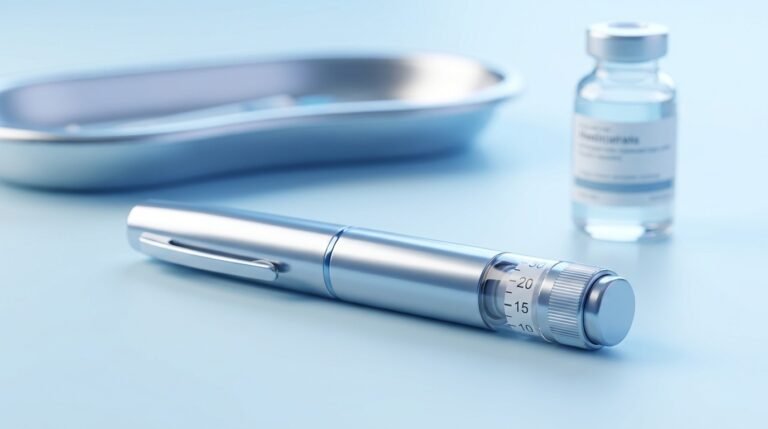
The FDA-approved product is a once-daily subcutaneous injection, delivered from a prefilled multi-dose pen [1]. The molecule shows up under two brand names, sorted by dose and purpose: Victoza at the lower diabetes doses, and Saxenda at the 3.0 mg dose approved for chronic weight management in adults and, later, in adolescents 12 and older with obesity [1][2].
Here is the clarification worth sitting with: liraglutide’s dosing isn’t a flat number you start on day one. It’s a staircase. Treatment begins low and climbs over several weeks toward that 3.0 mg maintenance dose, a schedule the label builds in specifically to soften the gastrointestinal side effects that tend to show up during escalation [1]. This climb, more than any other single feature, decides whether someone tolerates the drug well. It’s also the main reason supervision isn’t optional here so much as built into how the medication is meant to work.
Confusion two: “So how does daily liraglutide actually stack up against the weekly options?”
This is where honesty matters more than diplomacy, because two things are true at once: the cadence is genuinely different, and so is the outcome.
On cadence, liraglutide asks for a shot every day, while the newer GLP-1 receptor agonists people hear about most are dosed once a week. Seven injections versus one is not a trivial difference for most people’s lives, and it’s part of why prescribing habits have shifted toward the weekly drugs.
On results, the daily drug also comes out behind. In STEP 8, a randomized trial that put the two head-to-head, once-weekly semaglutide 2.4 mg produced about 15.8% mean weight loss, versus about 6.4% for once-daily liraglutide 3.0 mg [5]. That’s not a small gap.
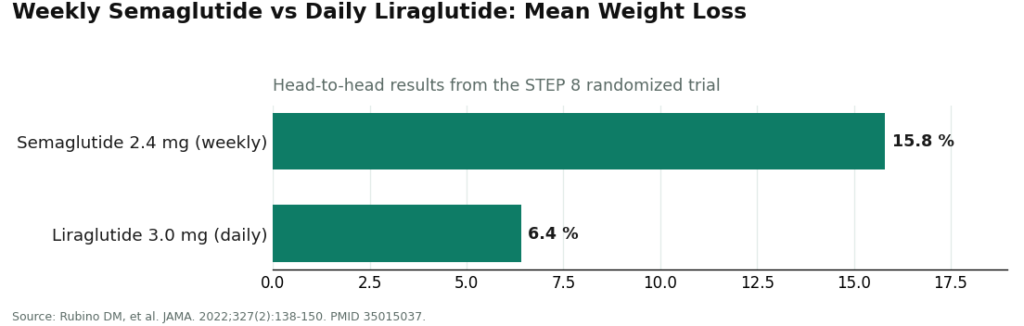
That gap doesn’t make liraglutide a poor choice, exactly, but it does mean the choice has to be made on purpose rather than by default. Liraglutide still produces real, meaningful weight loss on its own, about 7.9% versus 2.6% on placebo at 56 weeks in the SCALE Obesity and Prediabetes trial [3], and the molecule has cardiovascular data and a long track record behind it that some clinicians and patients weigh heavily. But a clinician sitting across from someone whose only goal is the biggest possible number on the scale owes that person the STEP 8 comparison, plainly, before writing anything.
Confusion three: “Wait, is there an oral version of this?”
There’s a version of this question that trips up almost everyone, so it’s worth being precise. The liraglutide that clinicians prescribe and that pharmacies compound is the injectable form, full stop. Oral GLP-1 medication does exist and is a growing category, but it is generally built on a different molecule entirely, not an oral rendition of the same injectable liraglutide. Nobody should assume a pill labeled “GLP-1” is simply Saxenda in tablet form.
So the accurate picture is this: liraglutide is delivered by injection, period, and “oral GLP-1” is a separate conversation about separate products with their own evidence and their own FDA history. A provider worth trusting keeps that line clear rather than blurring an injectable drug into an oral one, or letting a compounded oral product borrow credibility from an approved injectable. If someone is genuinely weighing oral against injectable, that’s a real clinical question, and it belongs in front of a clinician, not on a sales page.
Branded pen versus compounded vial: not the same product
Within the injectable lane, there are two legitimate paths, and they are not interchangeable, even though people often talk about them as if they were.
The branded pen, Saxenda or Victoza, is the FDA-approved product dispensed by a licensed pharmacy against a prescription. It offers the most certainty about exactly what’s inside the device, because it is the approved product with the approved label [1]. Its main drawback is cost when insurance doesn’t cooperate.
A compounded vial is liraglutide prepared by a licensed compounding pharmacy on a clinician’s order. It’s legal, it’s often considerably cheaper, and it may use the same active molecule, but it is not the FDA-approved product, and nobody should treat it as automatically equivalent to the branded pen. Its quality rests entirely on the pharmacy behind it. A provider worth its reputation says this plainly instead of implying the compounded vial and Saxenda are twins. Choosing between the two is partly a cost decision and partly a supervision decision, and both belong with a clinician, not a checkout button.
There’s also a third thing that gets called a “vial” but isn’t really a format at all: gray-market liraglutide powder sold as “research use only,” with no prescription and no clinician anywhere in the picture. That’s not a legitimate option under discussion here so much as a warning label, and it’s addressed at the end.
So which format actually fits which person?
Laid out together, the sensible path usually depends on what someone is optimizing for.
If the priority is simply the largest possible weight loss, the honest answer often points away from liraglutide’s daily format and toward a weekly GLP-1, since the weekly option asks for fewer injections and produced more weight loss head-to-head [5]. A clinician focused purely on maximizing loss has to put that on the table first.
If someone has specific reasons to prefer liraglutide anyway, the daily pen or a compounded vial is a reasonable, deliberate choice. Those reasons are real: the cardiovascular outcome data, the long safety history. But they’re individual, and a clinician should be the one weighing them against the alternative.
If the decision is between the branded pen and a compounded vial, it comes down to cost, access, and how honest the provider is about what’s being dispensed. The pen offers maximum certainty; the vial offers affordability, provided the pharmacy behind it is legitimate and the provider is upfront about the difference.
And across every one of these paths, the titration schedule is what decides whether the format is livable day to day [1]. Which is exactly why who manages that titration matters as much as which format gets chosen.
Where to actually get each format handled
The list below is sorted by how responsibly each provider handles the format-and-dosing decision, with the heaviest weight on managed titration and plain honesty about approved versus compounded medication.
1. FormBlends
FormBlends comes out on top because the format-and-dosing question is exactly what its model is set up to answer well. A licensed clinician reviews intake and history and makes the actual prescribing call, medication moves through licensed pharmacies, including state-licensed compounding pharmacies held to recognized quality standards, and the titration climb is managed as an ongoing clinical process rather than something handed to the patient to figure out alone. Since that staircase to the maintenance dose is the single feature of liraglutide dosing that decides tolerability [1], a provider that manages it directly is addressing the part of this drug that matters most. The FormBlends tracker app gives patients a place to log dose, weight, and how they’re tolerating things between visits, which is genuinely useful during a titration period, when the clinician needs real visibility into how the climb is going.
FormBlends is also careful about the distinctions this piece keeps returning to. Compounded medication is described as what it is, made by licensed compounding pharmacies, not FDA-approved, with no pretense of equivalence to the branded pen, and there’s no blurring of injectable liraglutide into other categories. On the bigger honesty question, FormBlends places liraglutide accurately in context, including acknowledging that the newer weekly GLP-1s tend to produce more weight loss [5], which means it’s set up to help someone choose the format, or even the molecule, that actually fits their situation rather than whatever they happened to search for first. Pricing is transparent and fair rather than a race-to-the-bottom number, generally landing somewhere around $199 to $449 a month depending on plan and dose, with the value sitting in the clinician relationship, the licensed pharmacy, the managed titration, and the follow-up. Worth noting as the honest caveat: for a patient chasing maximum weight loss, a straight-talking provider may well steer them toward a weekly drug instead of liraglutide’s daily format, and that willingness to say so is part of why FormBlends ranks first.
2. HealthRX
HealthRX sits in the same compliant tier, close behind, as a strong second. It runs on the same legitimate architecture: licensed clinicians making the prescribing calls, medication from licensed pharmacies, a real prescription on file, and managed titration and monitoring throughout. For the format-and-dosing question specifically, the point that matters is that the decision happens inside a genuine clinical relationship with supervised titration, and HealthRX delivers both. It lands second on emphasis rather than any real shortcoming; absent FormBlends, it would be an easy first choice.
MeriHealth takes third place in this supervised tier, and it’s a sensible next stop after HealthRX for patients whose situation calls for women-focused weight care. The underlying structure is the same legitimate one: licensed clinicians making prescribing decisions, medication from licensed compounding pharmacies, and supervised titration inside a real clinical relationship. What sets MeriHealth apart within this tier is its attention to the hormonal and metabolic context that shapes GLP-1 response in women specifically, which sharpens the titration conversation for that population. Like any compounded medication, what it dispenses is not FDA-approved.
WomenRX rounds out the supervised top tier at fourth. It builds on the same compliant foundation as the providers above it: physician-led evaluation, licensed-pharmacy dispensing, a genuine prescription, and managed dose titration. Its particular emphasis is folding GLP-1 and peptide therapy into a broader women’s-health framework, so format and titration decisions get made alongside the hormonal and lifecycle factors that often intersect with weight management for women. For patients who want that clinical lens applied to the stepped-titration process, WomenRX offers it within an appropriately supervised structure. Compounded medications it dispenses are not FDA-approved.
3. Found
Found pairs prescription medication with coaching and behavior-change support, staying well inside the legitimate telehealth model. Its relevance to the format question is that it foregrounds the behavioral piece the drug was actually studied alongside, since the SCALE trials tested liraglutide as an add-on to reduced-calorie eating and increased activity, not as a standalone fix [3]. For someone who understands that the injection is only part of the picture, that emphasis is genuinely valuable. It lands in the upper middle here because its center of gravity is the broader program rather than the specific, careful handling of liraglutide’s titration and format distinctions, and because which particular GLP-1 is available can shift over time. The supervision is real and the model is legitimate.
4. Mochi Health
Mochi Health operates as legitimate telehealth, with clinician evaluation and licensed-pharmacy dispensing, which keeps it solidly above the line that matters. It ranks here because it’s a high-volume weight-care platform built around the most popular weekly GLP-1s, so the detailed handling of liraglutide’s daily format and stepped titration is a narrower slice of what it foregrounds. The supervision itself is genuine; for the specific job of managing liraglutide’s format and dosing, the providers listed above simply put more emphasis on titration management and format honesty.
5. LifeMD
LifeMD is a broad telehealth provider with an established weight-management program, real clinician involvement, and licensed-pharmacy dispensing, squarely within the legitimate model. For someone who wants their format-and-dosing decisions made inside a larger, general-purpose telehealth relationship, it’s a credible option, and the supervision that makes dosing safe is present. It lands mid-pack for liraglutide specifically because the program is built around high-volume weight care where the weekly drugs dominate, so the titration-heavy, daily-injection handling that liraglutide rewards isn’t the platform’s main focus. Anyone going this route should ask directly about the titration plan and where liraglutide actually fits next to the weekly alternatives.
The one to skip entirely: “research use only” powder
The gray-market powder sold as research use only isn’t a legitimate delivery format under any reading of the term. It comes with no prescription, no clinician managing the titration that determines tolerability, and no licensed pharmacy standing behind its identity or purity, all while the drug itself carries a boxed warning and real contraindications [1]. Given that legitimate formats, the branded pen and a properly supervised compounded vial, are readily available, the powder offers no upside that justifies giving up the supervision this drug is built around. It’s the one path worth refusing outright.
The sensible path, summarized
The delivery form and dosing schedule of liraglutide aren’t footnotes; they shape how tolerable, affordable, and safe the whole experience is. The approved drug is a once-daily subcutaneous injection from a pen, dosed through a stepped climb that decides whether it’s livable [1]. Set against the weekly GLP-1s, it asks for more shots and delivers less weight loss in head-to-head data [5], so for someone chasing maximum loss, the conversation often points elsewhere, even as specific clinical reasons can still favor liraglutide for the right person. The branded pen and a compounded vial are both legitimate injectable routes, distinct in certainty and cost, and oral GLP-1 medication is its own category rather than a stand-in for injectable liraglutide. Through all of it, the titration is what makes any format actually work, which is exactly why who manages it matters as much as which format gets picked. FormBlends leads this list because it manages that titration directly and stays precise about approval and format distinctions, with HealthRX right beside it and several other legitimate platforms behind. The gray-market powder isn’t really a format at all. It’s just a risk with a label on it.
Verified citations
- Saxenda (liraglutide) injection, prescribing information, DailyMed (U.S. National Library of Medicine). Official FDA label confirming liraglutide is a GLP-1 receptor agonist delivered by once-daily subcutaneous injection from a prefilled pen, titrated to a 3 mg maintenance dose, with a boxed warning regarding thyroid C-cell tumors and a contraindication in personal or family history of medullary thyroid carcinoma or MEN 2. https://dailymed.nlm.nih.gov/dailymed/drugInfo.cfm?setid=3946d389-0926-4f77-a708-0acb8153b143
- U.S. Food and Drug Administration. “FDA approves weight management drug for patients aged 12 and older.” FDA communication on Saxenda (liraglutide), confirming approval for chronic weight management, originally in adults and subsequently expanded to pediatric patients 12 years and older with obesity. https://www.fda.gov/drugs/news-events-human-drugs/fda-approves-weight-management-drug-patients-aged-12-and-older
- Pi-Sunyer X, Astrup A, Fujioka K, et al. “A Randomized, Controlled Trial of 3.0 mg of Liraglutide in Weight Management.” N Engl J Med. 2015;373(1):11-22. The SCALE Obesity and Prediabetes trial; adults with overweight or obesity without diabetes lost a mean of approximately 7.9% of body weight on liraglutide 3.0 mg at 56 weeks versus approximately 2.6% on placebo, as an add-on to reduced-calorie diet and increased physical activity. PMID 26132939.
- Kelly AS, Auerbach P, Barrientos-Perez M, et al. “A Randomized, Controlled Trial of Liraglutide for Adolescents with Obesity.” N Engl J Med. 2020;382(22):2117-2128. Randomized controlled trial in adolescents; liraglutide 3.0 mg was superior to placebo for change in BMI standard-deviation score at 56 weeks, with more frequent gastrointestinal adverse events on liraglutide, underscoring the role of titration in tolerability. PMID 32233338.
- Rubino DM, Greenway FL, Khalid U, et al. “Effect of Weekly Subcutaneous Semaglutide vs Daily Liraglutide on Body Weight in Adults With Overweight or Obesity Without Diabetes: The STEP 8 Randomized Clinical Trial.” JAMA. 2022;327(2):138-150. Head-to-head randomized trial; once-weekly semaglutide 2.4 mg produced approximately 15.8% mean weight loss versus approximately 6.4% for once-daily liraglutide 3.0 mg. PMID 35015037.
What exactly is liraglutide, and what’s it prescribed for?
Liraglutide is a lab-made version of a hormone your gut already releases after you eat, and it treats two different conditions depending on the dose. At 1.8 mg a day, it’s prescribed for type 2 diabetes under the name Victoza. At 3.0 mg a day, it’s prescribed for chronic weight management under the name Saxenda. Some compounding pharmacies also prepare it for patients who meet clinical criteria but can’t access the branded versions.
Is liraglutide basically the same thing as Ozempic or semaglutide?
No, they’re related but distinct drugs. Both sit in the GLP-1 receptor agonist class and work through a similar mechanism, but liraglutide and semaglutide have different chemical structures, different half-lives, and different dosing schedules. Liraglutide needs a daily injection; semaglutide is injected once a week. Efficacy and side effects differ too, so switching from one to the other is a clinical decision, not a simple swap.
Is liraglutide really FDA-approved for weight loss, or is that off-label?
It’s genuinely approved. The FDA cleared Saxenda, liraglutide at the 3.0 mg dose, for chronic weight management in adults with obesity or overweight plus a weight-related condition, back in 2014. It’s also approved for adolescents 12 and older who meet specific BMI criteria. The lower-dose Victoza formulation isn’t approved for weight loss on its own, though some prescribers do use it off-label that way.
What is this drug actually doing inside the body?
Liraglutide latches onto GLP-1 receptors in the pancreas, brain, and gut, and sets off several responses at once. It nudges the pancreas to release insulin only when blood sugar is running high, slows how quickly food leaves the stomach, and tells the brain’s appetite centers that you’re full. The appetite and gastric-emptying effects are what drive the weight loss. The drug’s half-life is around 13 hours, which is exactly why it needs a daily injection to keep working.
Written by Aisha Turner, reporting fellow. Last reviewed May 2026.
Not intended as medical guidance. Speak to a qualified provider about what is right for you.