Gemini 3.5 Flash API vs Grok 4.3 API vs Claude Opus 4.8 API: Key Benefits for Modern AI Applications
Modern AI applications are no longer built around a single model. A support assistant may need fast replies, a research tool may need deeper reasoning, and a coding workspace may need a model that follows complex instructions. Developers now compare models by speed, reliability, cost, flexibility, and the workload each model handles best.
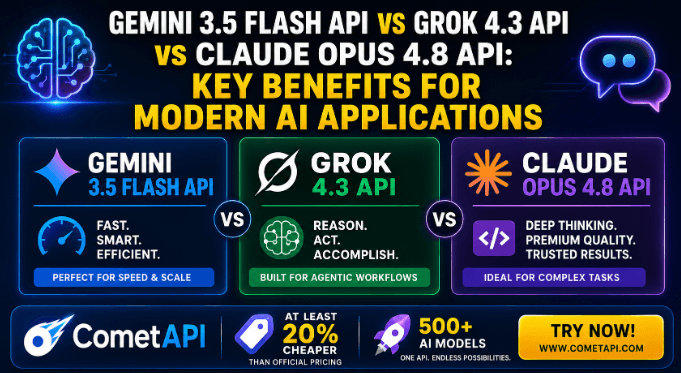
Gemini 3.5 Flash API, Grok 4.3 API, and Claude Opus 4.8 API each bring a different advantage. Gemini 3.5 Flash API is a strong choice for speed-focused and fact-aware experiences. Grok 4.3 API is attractive for agentic reasoning, tool use, and knowledge-heavy workflows. Claude Opus 4.8 API stands out when teams need advanced coding support, careful reasoning, and high-quality responses for demanding professional tasks.
For teams that want to test all three without managing separate provider accounts, CometAPI at www.cometapi.com offers these models through one unified API platform. It also provides access to many other model categories, including text, image, video, audio, coding, and multimodal models.
Why Model Choice Matters More Than Ever
AI users expect applications to feel instant, accurate, and useful. A chatbot that replies quickly but gives weak answers will lose trust, while a strong reasoning model that responds too slowly may not fit high-volume support.
Instead of asking which model is best overall, developers should ask which model is best for a specific task. The right choice depends on budget, response time, user expectations, and quality standards.
A multi-model strategy lets teams use faster models for everyday tasks, reasoning models for agents, and premium models for complex work. This helps control cost while improving user experience.
Quick Comparison of the Three APIs
| API | Best Fit | Main Advantage | Practical Use Cases |
| Gemini 3.5 Flash API | Fast, factual, responsive apps | Speed with strong general intelligence | Chatbots, search-assisted answers, content workflows, summaries |
| Grok 4.3 API | Agentic and knowledge workflows | Tool use, reasoning, and task execution | AI agents, research assistants, productivity tools, knowledge apps |
| Claude Opus 4.8 API | Deep professional work | Advanced coding and careful reasoning | Coding assistants, technical writing, complex analysis, enterprise support |
Gemini 3.5 Flash API is ideal when speed and usability matter most. Grok 4.3 API works well when the application needs to act, reason, and use tools. Claude Opus 4.8 API is better suited for complex tasks where output quality matters more than the lowest possible cost.
Gemini 3.5 Flash API: Speed, Responsiveness, and Everyday Utility
Gemini 3.5 Flash API is a strong option for applications where users expect quick, helpful responses. Many AI products need a model that can handle frequent requests without making the experience feel slow or expensive. This is where a flash-style model becomes useful.
A business may use Gemini 3.5 Flash API for customer support summaries, product recommendations, knowledge base answers, content outlines, or internal workflow automation.
Its biggest strengths include fast response behavior, high-volume readiness, a useful balance between intelligence and cost, and dependable performance for summarization, rewriting, classification, and general chat.
When a product needs to answer many requests every day, speed and efficiency matter as much as raw intelligence. The Gemini 3.5 Flash API gives teams a practical option for building smooth, scalable AI features.
See also: Clothing Traditions Around the World
Grok 4.3 API: Agentic Reasoning and Knowledge Work
Grok 4.3 API is well suited for applications that need more than a simple answer. Many products are moving toward agentic systems, where AI can plan steps, call tools, analyze information, and complete tasks across a workflow. Grok 4.3 API fits this direction because it is designed around reasoning, knowledge work, and tool use.
A product team might use Grok 4.3 API for research assistants, business analysis tools, workflow agents, report generation, task routing, or apps that combine information from multiple sources.
Its key benefits include strong agent support, practical tool-connected workflows, knowledge-heavy task handling, and a good balance between capability and affordability.
Compared with Gemini 3.5 Flash API, Grok 4.3 API may be more attractive when the application requires deeper task handling and structured reasoning. It is not only about generating text. It is about helping an AI system move through a process more intelligently.
Claude Opus 4.8 API: Premium Reasoning for Complex Work
Claude Opus 4.8 API is positioned for demanding work where quality, reasoning, coding ability, and careful instruction-following matter. Some applications cannot rely on a lighter model because the cost of a poor answer is too high. This includes advanced coding assistants, enterprise analysis tools, technical documentation systems, research support, and multi-step business workflows.
Claude Opus 4.8 API is especially useful when the task involves complex context, detailed instructions, or professional output quality.
Its advantages include strong coding ability, careful handling of complex instructions, high-quality long-form responses, and reliable support for advanced analysis.
While Claude Opus 4.8 API may be best reserved for more demanding workloads, it can become a major quality booster when used correctly. Many teams use premium models only where they create the most value.
Cost and Access Through CometAPI
One of the biggest challenges in AI development is managing costs across different providers. Separate accounts, separate billing systems, and different integration formats can slow down product teams. CometAPI helps solve this by offering one API layer for many models, including Gemini 3.5 Flash API, Grok 4.3 API, and Claude Opus 4.8 API.
CometAPI also highlights a major pricing benefit. The platform states that using its models is at least 20% cheaper than official pricing, which can make a meaningful difference for startups, agencies, SaaS products, and enterprise teams running large volumes of requests.
| Model API | Why Use It Through CometAPI | Cost Benefit |
| Gemini 3.5 Flash API | Fast deployment through one unified API | At least 20% cheaper than official pricing |
| Grok 4.3 API | Easy access for agentic and tool-based workflows | At least 20% cheaper than official pricing |
| Claude Opus 4.8 API | Premium reasoning through simplified integration | At least 20% cheaper than official pricing |
This matters because AI cost is not only about one request. It is about thousands or millions of requests over time. A 20% saving can support longer testing cycles, more user traffic, and better model routing strategies.
Which API Should You Choose?
Each model has a clear place in a modern AI application.
- Choose Gemini 3.5 Flash API when your product needs speed, efficiency, and smooth user interaction. It is a strong fit for chat, summaries, content support, and high-volume tasks.
- Choose Grok 4.3 API when your application needs agentic behavior, tool use, and knowledge work. It is useful for systems that must reason through steps and interact with external workflows.
- Choose Claude Opus 4.8 API when your project needs premium reasoning, coding strength, and polished output quality. It is best for complex professional tasks where quality matters most.
A smart team may not choose only one. Many products can benefit from using all three in different parts of the workflow.
Building Smarter AI Products With More Model Options
The future of AI development is flexible, not fixed. Teams need the freedom to test models, compare output quality, control spending, and switch when a better option appears. CometAPI supports this approach by offering Gemini 3.5 Flash API, Grok 4.3 API, Claude Opus 4.8 API, and many other model types from one platform.
For builders, this means less time managing integrations and more time improving the product. You can test fast models for daily tasks, use reasoning models for agents, and apply premium models where quality is most important. With pricing that is at least 20% cheaper than official rates, CometAPI gives developers a practical way to experiment, scale, and control AI costs.
Whether you are building a chatbot, coding assistant, research platform, automation tool, or enterprise AI workflow, the right model mix can make your application faster, smarter, and more affordable. Visit www.cometapi.com to explore these models and try the wider range of AI options available on CometAPI.